The Tennis Ball Myth: Why Felt Color Is Not the Whole Story
Tennis ball felt color helps visibility, but the core and covering shape how the ball feels, moves, and wears during everyday play.
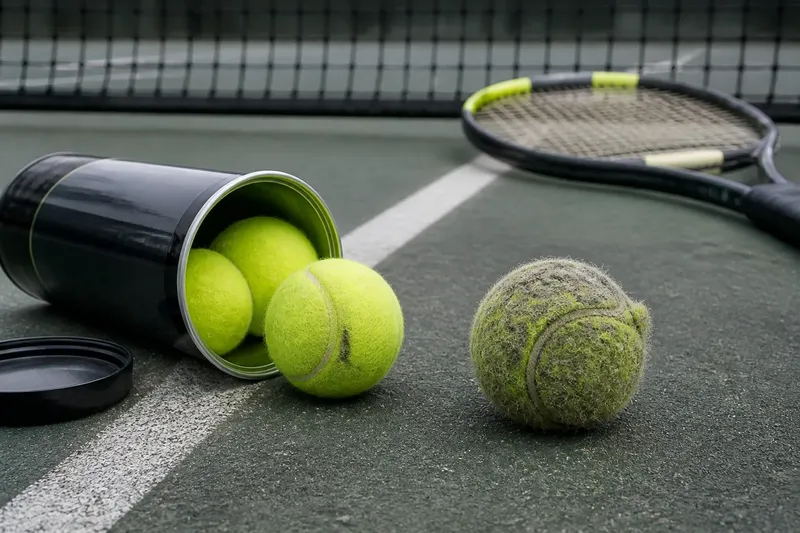
The common mistake is to treat a tennis ball’s bright felt as the whole ball. That assumption makes tennis ball felt color seem like a reliable guide to how a ball will play, when the visible nap is only one part of a pressurized, layered object.
Look at a ball in a can, then watch it bounce and scuff during play. The color helps players track it, but its response comes from the interaction of its core, rubber shell, felt covering, and condition. Knowing what each part does makes ordinary comments about “fast,” “heavy,” or “dead” balls easier to interpret.
Color and visibility
The familiar tennis ball is fluorescent yellow, though people often call it green. That difference is less a technical dispute than a matter of how the eye perceives the color under particular lighting and against a particular background. A ball can look more yellow on a dark court and greener beside a bright white line.
Color is chiefly a visual aid. The high-visibility shade helps the ball stand out against many courts, clothing, and surroundings. It does not tell you whether the ball is new, how much pressure remains inside, or how its covering will respond to contact.
There are exceptions in practice: recreational players may use balls in other colors, especially for instruction or visibility needs. Those choices do not mean that color alone determines bounce or suitability. Check the ball’s intended use and the setting rather than guessing from its appearance.
The core and bounce
Under the felt sits a hollow rubber core. Air pressure inside that core contributes to the ball’s rebound, while the rubber wall flexes and recovers as the ball strikes the court or a racket. The felt cannot substitute for that internal response.
Many standard tennis balls are pressurized. Their sealed core contains internal pressure that helps produce a lively bounce. Pressureless balls use a different construction and rely more on the rubber’s structure for rebound; they can feel different from a freshly opened pressurized ball, even when both are suitable for a recreational session.
That distinction explains why a ball can look clean but play poorly. A smooth-looking covering may conceal a ball that has lost liveliness. Conversely, a fuzzy ball may still have a useful bounce, though a worn covering can alter how it moves through the air and meets the racket.
What the felt does
The fuzzy covering is usually a woven textile bonded around the rubber core. Its nap gives the racket strings a textured surface to grip and helps create friction. That friction matters when players brush across the ball to produce spin.
Felt also affects drag as the ball travels through the air. A fresh, full nap and a flattened, worn nap do not present the same surface. This helps explain why players sometimes describe one ball as “fluffy” and another as “slick.” Those words refer to the cover’s condition and feel, not to a change in color.
As play continues, the fibers can fluff, flatten, pick up dust, or become damp. A ball that looks visibly fuzzy may catch the eye, but fuzz alone is not a dependable measure of its overall condition. Pay attention to the bounce, feel at contact, and whether the ball has become misshapen or damaged.
Reading ball talk?
Why does a new ball feel lively?
A new pressurized ball typically has a responsive core and an intact covering. Its bounce and contact feel can stand out beside balls used for many sessions, but the exact difference depends on ball type, court, and playing conditions.
Does extra fuzz mean more spin?
Felt texture can affect friction and drag, but fuzz by itself does not promise more spin. Racket strings, swing path, contact, and the ball’s condition all contribute to the result.
Why does a ball seem to slow down?
Players may call a ball slow when its covering has changed, its bounce feels less lively, or the conditions make it harder to move and track. “Slow” is a description of the playing impression, not a diagnosis of one particular component.
Can color identify the ball type?
Color can offer a clue about a ball’s intended audience or use, but it is not enough to identify its construction. Read the packaging or product marking for the intended court and level of play.
Condition in conversation
Players often use a single adjective for several sensations. “Heavy” might mean a ball feels less lively, takes effort to move, or seems to pick up moisture. “Dead” often means the bounce has faded. Ask what the speaker noticed: bounce, contact, flight, or visibility. That turns shorthand into useful information without pretending one word names a single cause.
Imagine you open a can of standard pressurized balls and compare them with a fuzzy ball from an old practice basket. The older ball appears more conspicuous because its nap has lifted, yet its bounce feels lower and its contact duller. The observable contrast would point to condition, not proof that the brighter-looking felt creates a livelier ball.
Choosing a ball
For a casual session, start with the ball’s intended use and the court you play on. Packaging may identify a ball as suitable for particular surfaces or for recreational, instructional, or competitive play. Different constructions can suit different preferences, so a familiar color is not a substitute for that information.
- Check the package for the stated ball type and intended use.
- Look for cuts, splits, or a noticeably uneven shape before play.
- Compare bounce with another ball of the same general type, if available.
- Notice whether the felt is flattened, shedding, or heavily marked.
- Keep damp or dirty balls out of a comparison with clean, dry ones.
- Use the product directions and any local competition rules when selecting balls for organized play.
These checks help separate a visual impression from a playing characteristic. A scuffed ball is not automatically unusable, and a bright, clean ball is not automatically lively. For competition, labels and governing rules matter; for a relaxed hit, choose a ball that gives a consistent feel for the session.
Beyond the visible felt
When someone says a tennis ball looks different, the color may be the first thing noticed, but it is only one clue. The core supports rebound, the covering affects contact and airflow, and appearance helps players see the ball against its surroundings. Those roles overlap in play, yet they are not interchangeable.
Next time a ball seems strange, name the sensation before blaming its shade. Ask whether the bounce has faded, the felt has changed, or the ball is simply difficult to see in the light. That small distinction makes tennis ball felt color easier to discuss—and leaves room for the rest of the ball to explain what your eyes cannot.